
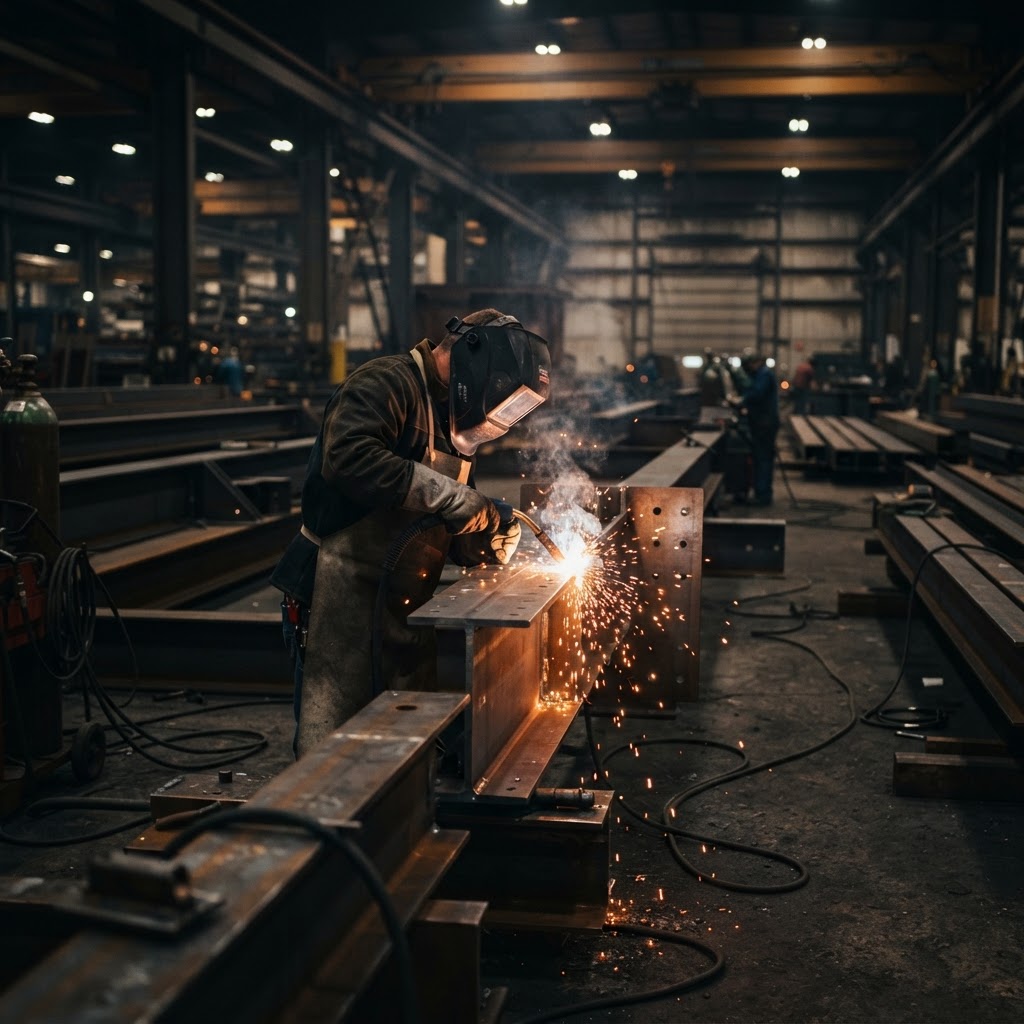
What to Look for in a Structural Steel Fabricator: A Guide for Contractors and Engineers
When a project calls for structural steel or bridge components, the fabricator you select can make or break your schedule, your budget, and in some cases, the long-term safety of the structure. Yet many project owners and even experienced general contractors evaluate fabricators primarily on price and lead time, overlooking the certifications and quality systems that actually predict whether a shop will deliver conforming, code-compliant work.
This article breaks down the key factors that separate a reliable fabrication partner from a risky one, so you can ask better questions during the bid process and avoid costly surprises in the field.
Why AISC Certification Matters More Than a Logo
The American Institute of Steel Construction (AISC) Quality Certification Program is often treated as a checkbox on a bid sheet, but it represents a rigorous, audited quality management system that covers far more than welding technique.
An AISC-certified fabricator has demonstrated documented control over:
- Material traceability from mill certification through finished product
- Welding procedure specifications (WPS) and welder qualification records
- Detailing and shop drawing review processes
- Nonconformance tracking and corrective action
- Coating and surface preparation standards
Certification categories matter too. A shop certified for "Simple Steel Bridges" (SBD) or "Major Steel Bridges" (CBR) has passed a more stringent audit than one certified only for conventional building steel. If your project involves a DOT bridge, overpass, or any structure governed by AASHTO specifications, confirming the fabricator's specific certification category — not just the general AISC designation — should be one of the first questions in your pre-qualification process.
For public infrastructure work, many state DOTs maintain their own approved fabricator lists that cross-reference AISC and AWS credentials. It's worth checking that list early rather than discovering a disqualification after award.
Understanding Welder Qualifications and Procedure Specs
A common misconception is that "a welder is a welder." In reality, every welder working on structural or bridge steel should be qualified to a specific Welding Procedure Specification (WPS) that has itself been qualified through a Procedure Qualification Record (PQR) per AWS D1.1 (Structural Welding Code – Steel) or AWS D1.5 (Bridge Welding Code).
Why This Distinction Matters for Your Project
A welder qualified for flat-position fillet welds on 3/8-inch plate is not automatically qualified for full-penetration groove welds on 2-inch flange material in the overhead position. Reputable shops maintain welder continuity logs and requalify personnel when there's a lapse in process use exceeding six months, as required by code.
When reviewing a fabricator's qualifications, ask to see:
- Current welder certification records tied to specific processes (SMAW, FCAW, GMAW, SAW)
- WPS/PQR documentation for the joint types and material thicknesses your project requires
- Nondestructive testing (NDT) protocols — ultrasonic testing (UT), magnetic particle (MT), or radiographic testing (RT) depending on weld type and governing code
This is especially critical for fracture-critical bridge members, where a single flawed weld can compromise redundancy in the load path.
Aluminum vs. Structural Steel: Different Metals, Different Expertise
Searches for "aluminum welding" and "structural steel" often come from different corners of the same industry, but the two materials demand distinct skill sets. Aluminum's lower melting point, higher thermal conductivity, and tendency toward porosity require different shielding gas mixtures, heat input control, and often different filler metals than carbon or structural steel.
Aluminum fabrication is common in:
- Marine and dock structures
- Transportation equipment and trailers
- Architectural facade components
- Light-gauge industrial platforms
If your project scope includes both steel framing and aluminum components — say, a structural frame with aluminum railing or decking — confirm that the shop has separate, current qualifications for both metal groups. A shop that excels at heavy structural steel doesn't automatically have the GTAW (TIG) proficiency that quality aluminum welding demands.
Shop Capacity and Its Impact on Schedule
Estimators frequently underweight shop capacity when comparing bids. A fabricator quoting an aggressive price may be operating near full capacity, which can quietly extend your actual delivery date regardless of what the proposal states.
When evaluating capacity, consider:
- Total square footage and crane capacity (tonnage and hook height) relative to your heaviest piece marks
- Current backlog and realistic start date, not just stated lead time
- In-house capabilities versus outsourced processes (blasting, galvanizing, specialty coatings) — every outsourced step adds a logistics dependency and potential delay point
- Shipping capability, particularly for oversized or overweight loads requiring permits across state lines
A 60,000-square-foot shop with overhead crane coverage across its full bay length can typically handle longer girder sections and heavier plate assemblies in a single lift, reducing field splice requirements — a detail worth discussing with your detailer during the connection design phase.
Questions Worth Asking Before You Award the Contract
Beyond price, a short pre-award conversation can surface issues that would otherwise appear mid-project:
- What is your current AISC certification category, and when was your last audit?
- Can you provide WPS/PQR documentation specific to our material thickness and joint configuration?
- What NDT methods do you perform in-house versus through a third party?
- What is your current shop backlog, and when would fabrication realistically begin?
- Do you have experience shipping to our project's geographic region, including any permit requirements for oversized loads?
Conclusion
Selecting a fabrication partner is a technical decision disguised as a procurement decision. The certifications, welder qualifications, and shop capabilities discussed here directly affect whether steel arrives on-site ready to erect, on schedule, and free of the nonconformance issues that trigger costly rework. Taking the time to verify these details during pre-qualification — rather than after a purchase order is signed — is one of the simplest risk-mitigation steps available to contractors, engineers, and project owners alike.